


Interdisciplinary research on cultural entanglements and contemporary practices across art, theory,
and society.
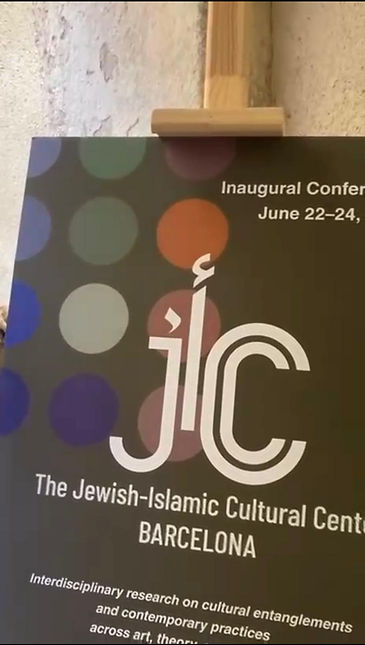


Photos: Samson Karapetyan
Introduction
For more than fourteen centuries, Jews and Muslims have lived in close geographical proximity across the Mediterranean, the Middle East, and North Africa.
This long historical encounter generated rich forms of intellectual, cultural, and social exchange, evident in philosophy, poetry, liturgy, music, architecture, and everyday life. Intellectual traditions developed through dialogue across languages such as Arabic, Hebrew, Ladino, and Judeo-Arabic, while shared social spaces fostered mutual influences that shaped both communities in profound ways.
Despite this long history of interaction - at times peaceful and productive, at times conflictual - Jewish-Muslim cultural entanglements have often been marginalized in modern academic and public discourse.
Political transformations in the modern era, including the collapse of the Ottoman Empire, the rise of nationalist movements, and the influence of European colonial frameworks, contributed to narratives that increasingly framed Jewish and Muslim identities as fundamentally opposed. As a result, centuries of coexistence, collaboration, and shared intellectual life have often been overshadowed by interpretations that emphasize conflict.
Even today, relations between these communities are not free of tension and all too often take the form of political and cultural confrontation.
Vision
The Jewish-Islamic-Culture Center (JICC) in Barcelona seeks to revisit and reactivate this shared historical experience as a critical framework for rethinking contemporary cultural relations.
Rather than approaching Jewish-Muslim relations primarily through the lens of conflict, the center emphasizes the long traditions of intellectual exchange, artistic creativity, and social interaction that shaped the shared cultural landscape of the Mediterranean.
Location and Operational Framework
The Jewish-Islamic-Culture Center (JICC) operates under the framework of the Instituto de Estudios Judíos de Barcelona (EJB),
in a city historically situated at the crossroads of European and Mediterranean cultures and networks of exchange - and today home to active Jewish and Muslim communities.
It aims to serve as an interdisciplinary platform bringing together scholars, artists, and cultural practitioners. Through seminars, research initiatives, artistic residencies, exhibitions, film screenings, and public conversations, the center will explore both historical encounters and contemporary cultural practices emerging at the intersection of Jewish and Muslim worlds.
By integrating academic research with artistic and public programming, the center seeks to cultivate new forms of cultural dialogue and critical reflection on shared heritage, collective memory, and possibilities for coexistence.
In a time marked by growing polarization and political tensions, the project affirms that Jewish-Islamic cultural history offers not only a record of the past but also a vital intellectual and cultural resource for imagining more dialogical and sustainable futures in the Mediterranean and beyond.
JICC - Steering Committee
Prof. Yossi Yonah – Ben-Gurion University of the Negev (Emeritus) - Chairman
Prof. María Ángeles Gallego García - ILC-CSIC
Dr. Erica Consoli - University of Barcelona
Dr. Mª Ángeles (Angy) Cohen García-Juez - CCHS-CSIC
Prof. Tamar Shuali Trachtenberg - Universidad Católica de Valencia
Mr. Sharon Toval – Curator and Researcher of contemporary art
Arch. Nathalie Kertesz – Curator & Artistic director LABA BCN
Prof. Yuval Evri - Brandeis University
Dr. Ktzia Alon - Researcher, Literary Scholar, and Cultural Activist
Mr. Ami Steinitz - Independent Curator, Cultural Activist, and Educator
Dr. Ze`ev Maor - Instituto de Estudios Judíos de Barcelona (Institute for Jewish Studies of Barcelona, EJB)


