


Texts & Reflections


Midrashim
for Yamim Noraim
Prof. Ruchama Weiss
following the Sages of the Talmud


ZMAN EMET – Real Time
A Space for Thought in a Time of Emergency
The multidimensional catastrophe in Israel and Gaza, sending shockwaves across the globe, has generated a profound crisis of interpretation and identification, and an urgent need to revisit enduring questions of political theology, Jewish values, democracy, and Israel.
There is a pressing need to examine and analyze the erupting present through the lens of the “long durée,” and to attempt - amid the noise - to discern the depth of the transformations both underway and required. At the same time, in the face of the unfolding humanitarian disaster, there is an equally urgent call to act.
ZMAN EMET is a gathering initiated by the Institute for Jewish Studies, JCall Spain, and The Barcelona Jewish Film Festival, dedicated to study, dialogue, and action. It embraces complexity - a forum for questions without easy answers, a space for learning and unlearning, for political imagination, and for collective engagement.
Past Encounters:
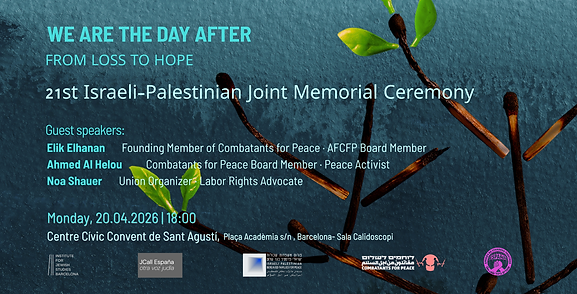
21st Joint Israeli-Palestinian Memorial Ceremony. This event, organized internationally by Combatants for Peace and the Parents Circle – Families Forum, brought together voices from across Israel and Palestine in a shared act of remembrance and a clear rejection of violence as an inevitable reality. Held on April 20, 2026, at the Centre Cívic Convent de Sant Agustí in Barcelona, the gathering offered local participants the opportunity to engage with one of the most significant initiatives of non-violent Israeli-Palestinian co-resistance. The ceremony featured powerful testimonies from bereaved families, alongside messages from human rights advocates and moments of music, all grounded in the belief that mutual recognition of suffering is essential for any path toward peace. We where especially honored to welcome peace activists Elik Elhanan, Ahmed Al Helou, and Noa Shauer, who joined live in Barcelona and contributed their voices and personal experiences to the event. Their presence reinforced the urgency and humanity behind the ongoing efforts for dialogue and reconciliation. Through this initiative, EJB sought to amplify a message of hope, solidarity, and shared humanity. At a time marked by deep divisions and ongoing conflict, the ceremony stood as a reminder that alternative paths—rooted in empathy, dignity, and cooperation—remain possible.

Conversation with Ibrahim Abu Ahmad. Ibrahim Abu Ahmad, co-creator of the podcast and blog Unapologetic: The Third Narrative Unapologetic: The Third Narrative (UTTN) was founded after October 7 by Ibrahim Abu Ahmad, a Palestinian citizen of Israel (’48), and Amira Mohammed, a Palestinian from East Jerusalem (’67), as an independent Palestinian-led initiative that challenges rigid narratives and amplifies voices that are often silenced or misrepresented. The project emerged as a Palestinian-led initiative committed to amplifying voices that are often silenced or misrepresented. It was created in response to decades of deeply polarized narratives around Israel and Palestine, with the explicit aim of generating a different kind of discourse – one that challenges rigid frameworks and seeks real alternatives. The conversation will focus on the lived realities of Arab citizens of Israel since October 7, as well as the political and social context in the period leading up to the Knesset elections. A Third Narrative seeks to foster an inclusive community committed to nonviolence and to the pursuit of real solutions, advancing a vision that does not merely mediate between sides but aims to transform the conversation itself and open the possibility for meaningful change. Online lecture | 25.2 | 19:00 Zoom link will be sent upon registration.

Hillel Cohen - In conversation, On the occasion of the publication of his new book: Between the River and the Sea: My Travels in Israel and Palestine by Hillel Cohen & Yana Bukler “This is a memoir written and illustrated during wartime - between sirens and funerals, between news reports and the urge to escape them, between sinking into everyday routine and a tense alertness in the face of historical upheavals, between gray despair and the search for hope.” These words open Hillel Cohen’s new illustrated memoir, Between the River and the Sea: My Travels in Israel and Palestine, in which Cohen lays out the story of his life - five decades of movement between the narratives of two peoples. Born into a religious, national-Zionist family, Cohen feels at home in Palestinian villages and moves between Hebrew and Arabic - as a soldier, journalist, and social activist. The book traces his journeys between peoples against the backdrop of major historical developments, from the establishment of the Palestinian Authority to the collapse of the peace process. Written in the aftermath of October 7, 2023, the book seeks to bring readers, with compassion and care, the different perspectives of Jews and Arabs in Israel and Palestine on the current situation. About the speaker Hillel Cohen is a Jerusalem-based scholar and one of the leading researchers of the Israeli–Palestinian conflict. He teaches in the Department of Islam and Middle Eastern Studies at the Hebrew University of Jerusalem. He is the author of six books dealing with different aspects of Jewish–Arab relations in Israel and Palestine, including the bestsellers 1929: Year Zero of the Jewish–Arab Conflict and Good Arabs: The Israeli Security Agencies and the Arabs in Israel. January 14 at 7:00 PM Image illustration: Yana Bukler, from the book Between the River and the Sea: My Travels in Israel and Palestine.

Norma Musih is a researcher of visual culture and digital media at the Hebrew University of Jerusalem, where she studies future-imagining works and political imagination at the intersection of political theory, communication, and cultural studies. Her current research also examines contemporary artworks that imagine futures in the Middle East. Norma writes about her lecture: These are difficult times globally, and most acutely in Palestine–Israel. Imagining a future beyond ongoing cycles of violence and war feels increasingly impossible. The political deadlock we face reflects a deeper crisis: a crisis of political imagination. Drawing on the work of Hannah Arendt, I will examine the relationship between imagination and images and the dialectical interplay between them. We will explore political imagination as a practice requiring active cultivation, and consider ways to train it through a dialectical movement between past, present, and future -opening possibilities for political transformation. In addition, Musih will discuss works by activists who use artistic creation to visualize possible futures, showing how art can function as a political laboratory for imagination and alternative horizons. Join us on Wednesday, December 3rd, at 18:00 The lecture will be available on Zoom and can also be attended in a group-listening session at Casa Adret, Barcelona - Carrer de Salomó ben Adret 6, 08002 Barcelona. Simultaneous translation will be available only on Zoom; it will not be available during the group listening session at Casa Adret.

Prof. Liska is internationally recognized for her work on Franz Kafka, Walter Benjamin, and contemporary Continental philosophy. As Professor of German Literature and Director of the Institute of Jewish Studies at the University of Antwerp, she has significantly shaped global discussions on Jewish modernity, exile, memory, and the intersections between ethics, literature, and otherness. Her writing is marked by intellectual precision, philosophical depth, and a sustained engagement with the legacy of European Jewish culture. Tuesday, November 26, 18:00

THE OCCUPATION FROM WITHIN – CONVERSATION WITH MICHAEL SFARD In this talk, Michael Sfard will present the dilemma he faces working within the Israeli judicial system: the challenge of fighting against occupation and apartheid through the very same legal system of the state that enforces them. This dilemma is the central theme of his book The Wall and the Gate. After reviewing the historical context, Sfard will discuss how this dilemma has manifested in the past two years during the war on Gaza. He will also answer questions related to the “judicial overhaul,” a topic he explored in his book The Occupation from Within, as well as about his experiences over the past two years in Israel as a political activist opposing the war. Michael Sfard is an Israeli human rights lawyer and political activist specializing in human rights and the laws of war. For more than two decades, he has represented hundreds of Palestinian individuals, families, and communities, as well as human rights and peace organizations, before Israel’s Supreme Court. He serves as legal counsel for Yesh Din and Peace Now. A conscientious objector himself, he has also represented hundreds of Israeli soldiers who refused military service. An expert on West Bank settler colonies and the daily challenges and harassment faced by Palestinians under Israeli occupation, Sfard is considered both one of the most respected and most feared human rights lawyers in Israel. In 2011, a settler from Kiryat Arba publicly called for his assassination. The far-right Israeli watchdog NGO Monitor described Sfard as “the hub of the NGO sector that exploits human rights rhetoric.” He is the author and co-author of several books, including The Wall and the Gate: Israel, Palestine and the Legal Battle for Human Rights (2018) and The Occupation from Within: A Journey to the Roots of the Constitutional Coup (2025). He has also written numerous articles published in Haaretz, The Independent, and The New York Times, among others. In his writings, he denounces the regime of Jewish supremacy in the State of Israel. Sfard is the grandson of Zygmunt Bauman, the Polish Jewish sociologist who escaped the Nazis. ONLINE EVENT – PRE-REGISTRATION REQUIRED
WHAT BECAME OF THE HUMANIST VALUES OF THE JEWISH TRADITION? The creation of the State of Israel was not only aimed at providing a refuge for the Jews of the diaspora and thus resolving the “Jewish question.” It also sought to ensure that the values of the Jewish tradition, developed over 2,000 years of exile, would influence the governance of the country. These values of Judaism extend justice and compassion to all human beings. Today, both Jews and non-Jews who feel a special attachment to the State are asking where those values are, given the death and destruction in Gaza. We will present and discuss some of these values through biblical and rabbinic texts. Rabbi Stephen Berkowitz, born in New York and ordained by the Reconstructionist Rabbinical College of Philadelphia in 1986, has served in Reform and Masorti congregations in the United States, France, Belgium, and Spain over the past forty years. He resides in France with his wife Isabelle, one of the founders of JCall Spain.
In collaboration with:

